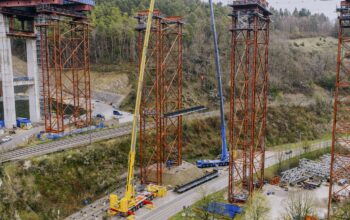
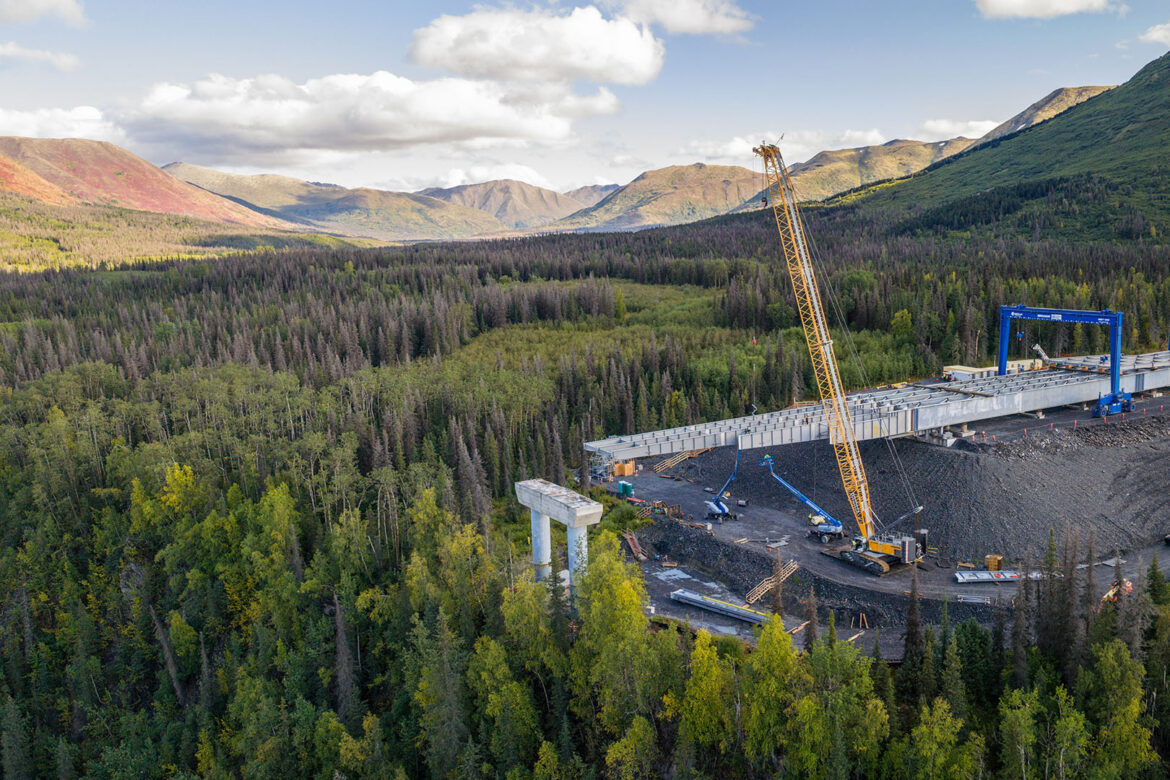
The construction of the 290-meter Juneau Creek Bridge is at the heart of a major infrastructure project in Alaska. It is designed to improve traffic capacity on the Sterling Highway between Anchorage and the Kenai Peninsula, while also enhancing safety. Traylor Bros, Inc. is using two Liebherr LR 1300.1 SX crawler cranes to assemble the steel sections of the bridge.
The steel beams are assembled on one side of the canyon and then gradually pushed towards Cooper Landing using hydraulic presses, according to the "bridge launch" technique. This method allows the sections to be positioned accurately without complex scaffolding. "The first beams were the most difficult to lift. The wind was blowing at up to 40 mph, so we had to coordinate the team on the ground. We have two cranes, one on each side, which makes the maneuver easier," explains crane operator Travis Ludlow. He highlights the usefulness of the Gradient Travel Aid, which allows the crane to climb slopes while remaining in a safe zone.
The steel beams must be aligned with millimeter precision to ensure the stability of the bridge. According to Tyler Becker, senior engineer on the project, the reliability and lifting capacity of the LR 1300.1 SX cranes were decisive: "Any delay due to a breakdown would have compromised the schedule. These cranes enable us to carry out all the necessary operations."
Planning is based on 3D Crane Planner 2.0 software, which simulates lifts and anticipates constraints related to slopes, limited access roads, and extreme weather conditions. The bridge must also be earthquake-resistant and preserve the local ecosystem.
On its 18th anniversary, the two latest versions of the LR 1300 model are being used on this project in a spectacular setting, gradually bringing the banks of Juneau Creek closer together.