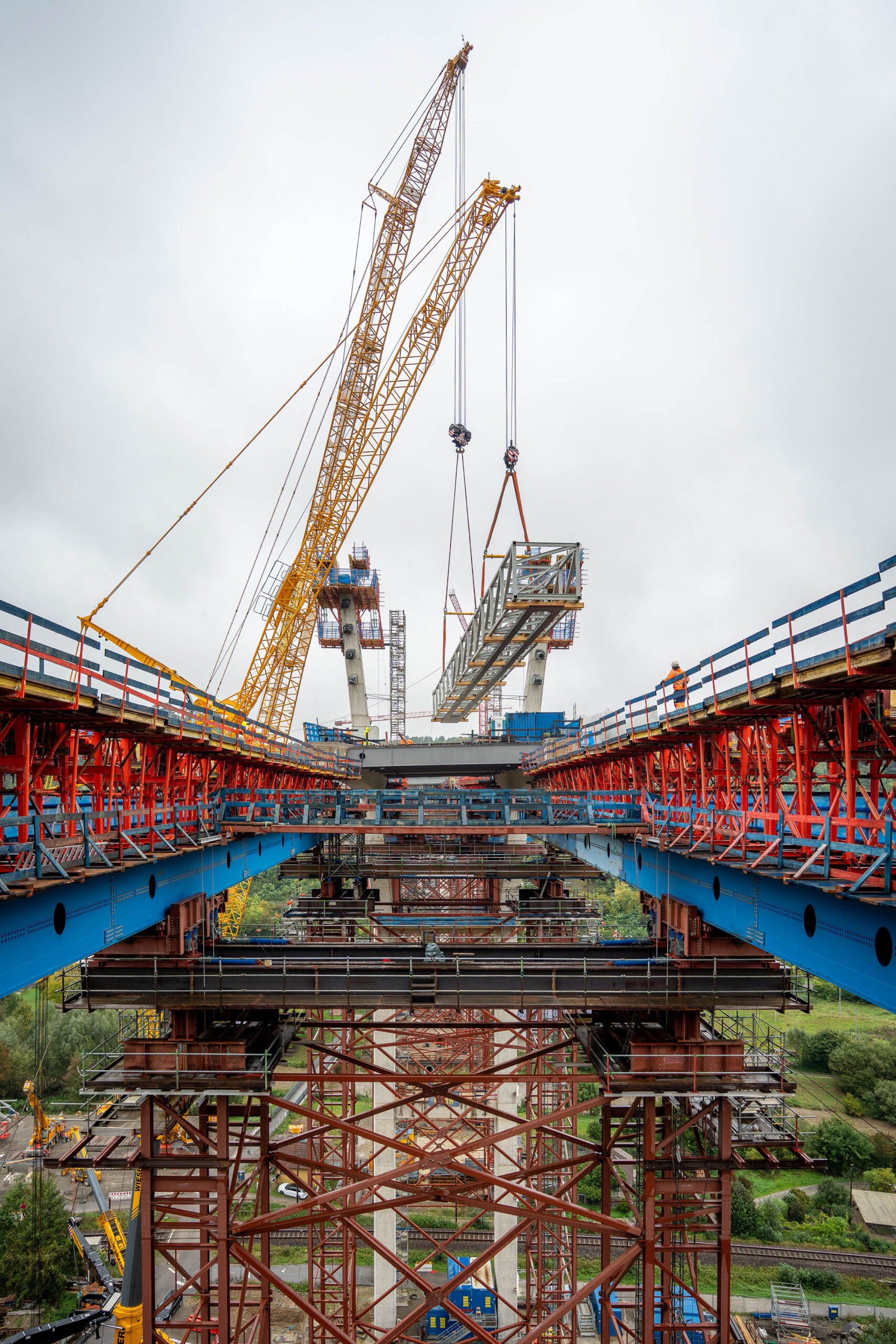
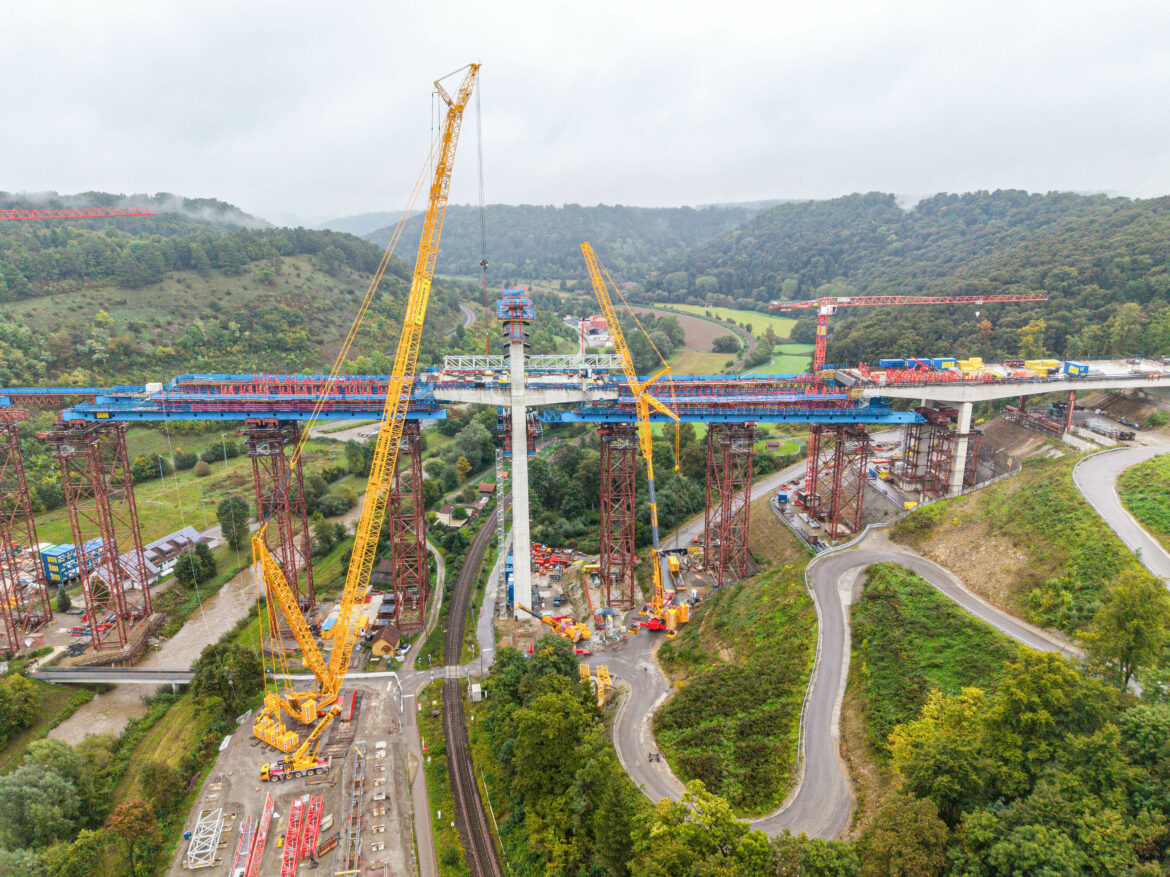
Au-dessus de la vallée du Neckar « la route des châteaux allemands » près de Karlsruhe, dans le Land allemand , un chantier d’envergure attire actuellement tous les regards : dans le cadre de la nouvelle déviation de Horb, le Conseil régional de Karlsruhe fait construire un pont « Hochbrücke Horb » de 667 mètres de long et 65 mètres de haut, destiné à faire passer la route fédérale B32 au-dessus du fleuve. Pour cette opération de levage, Wiesbauer GmbH & Co. KG a mobilisé deux grues Liebherr, une grue sur chenilles LR 1700-1.0 et une grue mobile LTM 1650-8.1, afin d’installer d’imposantes plaques d’acier sous les deux tabliers du pont.
La conception du pont « Hochbrücke Horb » repose sur le principe de l’« extradossé », une technique moderne combinant les avantages des ponts à haubans et des ponts en béton précontraint. Ses pylônes relativement bas et ses tabliers en béton élancés confèrent à l’ouvrage une silhouette légère et élégante. Pour garantir la résistance aux fortes charges de flexion, des plaques d’acier continues ont été fixées sous les tabliers à l’aide de milliers de goujons d’ancrage. Ces éléments sont tout sauf légers : leur épaisseur varie de 7 à 14 cm, pour des longueurs pouvant atteindre 157 mètres.
Plutôt que de souder les plaques section par section sur le pont une méthode qui aurait retardé les travaux de plusieurs semaines, Wiesbauer a fait le choix de les assembler au sol en éléments complets. Résultat : des charges atteignant jusqu’à 70 tonnes par plaque, portées à 85 à 102 tonnes avec les accessoires de levage. Ces ensembles ont ensuite été hissés à 65 mètres de hauteur pour être fixés sous le pont.
Pour ces opérations, la LR 1700-1.0 était équipée d’une flèche principale de 132 m, d’une fléchette fixe de 12 m et de 375 tonnes de contrepoids. La LTM 1650-8.1, quant à elle, disposait de son système de haubanage Y-guying, de 155 tonnes de contrepoids, d’une rallonge télescopique de 16 m et d’une fléchette relevable de 38,5 m.Positionnée au centre de la vallée, la LR 1700-1.0 a pu réaliser seule les levages les plus lourds. Pour les positions plus éloignées, un levage en tandem avec la LTM 1650-8.1 s’est avéré nécessaire. La grue sur chenilles déposait d’abord la plaque sur une zone accessible du tablier, avant que les deux machines ne déplacent la charge à son emplacement final avec une précision au millimètre.
Le système VarioTray et le V-Frame ont joué un rôle clé dans le succès de l’opération, permettant d’ajuster en continu le rayon du contrepoids de 13 à 21 mètres. « Sans VarioTray et V-Frame, cette mission n’aurait pas été possible », confie le grutier Ralf Paladey. « Nous avons dû ajuster le rayon du contrepoids en permanence pour garder l’équilibre parfait. » Lors des levages en tandem, la grue sur chenilles a atteint un rayon de travail de 96 mètres.
L’installation des grues a elle-même représenté un défi logistique majeur. Le site, coincé entre le Neckar au nord et une voie ferrée au sud, ne laissait que peu de marge. Tous les composants ont dû être transportés sur des remorques à huit essieux pour accéder au fond de la vallée par des routes sinueuses. « Même le montage était une opération de précision », souligne Ralf Hofmann, conducteur de la LTM 1650-8.1. « Lors de l’installation de la fléchette, il ne restait qu’un mètre de dégagement. » Avant l’intervention, Wiesbauer a simulé l’ensemble des mouvements et contraintes à l’aide du logiciel de planification Liebherr LICCON et d’un outil de CAO. « Dans ce type d’opération, l’expérience fait toute la différence », explique le grutier Tim Moll. « Les calculs ne suffisent pas : il faut avoir le bon “feeling” pour la charge et la position du contrepoids. »